Adjudication vs Enrollment
How participants are classified at enrollment and how the Adjudication Committee assigns a primary kidney disease category.
Enrollment vs Primary Adjudicated Category
This document outlines the categorization of KPMP participants following enrollment and adjudication.
The goal of the KPMP Adjudication Committee is to review participants enrolled in KPMP and classify them into kidney disease categories that are considered the primary cause of the participant’s kidney disease based on clinical and pathological data. Additional causes noted in adjudication are available in the Core Clinical File and can be made available with a signed Data Use Agreement (DUA).
Categorization
Each participant is sub-categorized in different cohorts or disease classes at different steps of assessment
- Enrollment categories - participants enter the study classified in the following broad categories prior to kidney biopsy. Recruitment site investigators and research coordinators use study inclusion/exclusion criteria to determine the participant’s enrollment category. Refer to the KPMP protocol for more details on inclusion criteria.
- Healthy Reference: participant donating a kidney or undergoing treatment for kidney stones
- Chronic Kidney Disease (CKD): diagnosis of diabetes OR hypertension (based on inclusion criteria) AND evidence of persistent kidney damage (based on inclusion criteria)
- Acute Kidney Injury (AKI): evidence of acute kidney injury (based on inclusion criteria)
- Diabetes Mellitus Resilience (DM-R): participant has had diabetes for more than 25 years and has no clinical signs of kidney disease (based on inclusion criteria)
- Primary Adjudicated categories - upon review of the clinical and pathologic characteristics, participants are categorized using primary and secondary disease categories. The primary disease category reflects a consensus of pathologists and nephrologists on the primary cause of the participant’s kidney disease. The Primary Adjudicated categories are the following:
- Acute Interstitial Nephritis: inflammatory infiltration into the tubulointerstitium considered to be caused by drug exposure or other etiologies
- Acute Tubular Injury: clinical and histologic features of acute tubular injury
- Cannot be determined: the pattern of injury did not fit any known kidney disease agreed upon by the adjudication committee or the predominant pattern of injury could not be determined amongst several plausible underlying kidney diseases, or there was not enough information (clinical or limited tissue sample)
- Diabetic Kidney Disease: histologic features consistent with diabetic kidney disease in an individual with a history of diabetes
- Hypertensive Kidney Disease: histologic features consistent with hypertensive kidney disease in an individual with a history of hypertension
- Other: another kidney condition, including IgA nephropathy, focal segmental glomerulosclerosis, membranous nephropathy, fibrillary glomerulonephritis, etc. More specific diagnoses are available for release with a DUA.
Adjudication Process
The Adjudication Team at KPMP comprises a group of Pathologists and Clinicians. Each participant’s case is reviewed with the following information:
- Whole Slide Images in Digital Pathology Repository (DPR)
- Clinical Packet: REDCap participant reported medical history, medications, and lab data completed by the recruitment site
- Pathology Packet: Diagnostic core disease category assessment REDCap form
- Electron Microscopy (EM) Images
- Recruitment Site Pathologist generated pathology report
Upon review of the materials, the KPMP adjudicators (clinicians and pathologists) meet and reach a consensus of primary and secondary categories and record in KPMP’s REDCAP Adjudication form.
Data is available in our Core Clinical File and is accessible with a DUA.
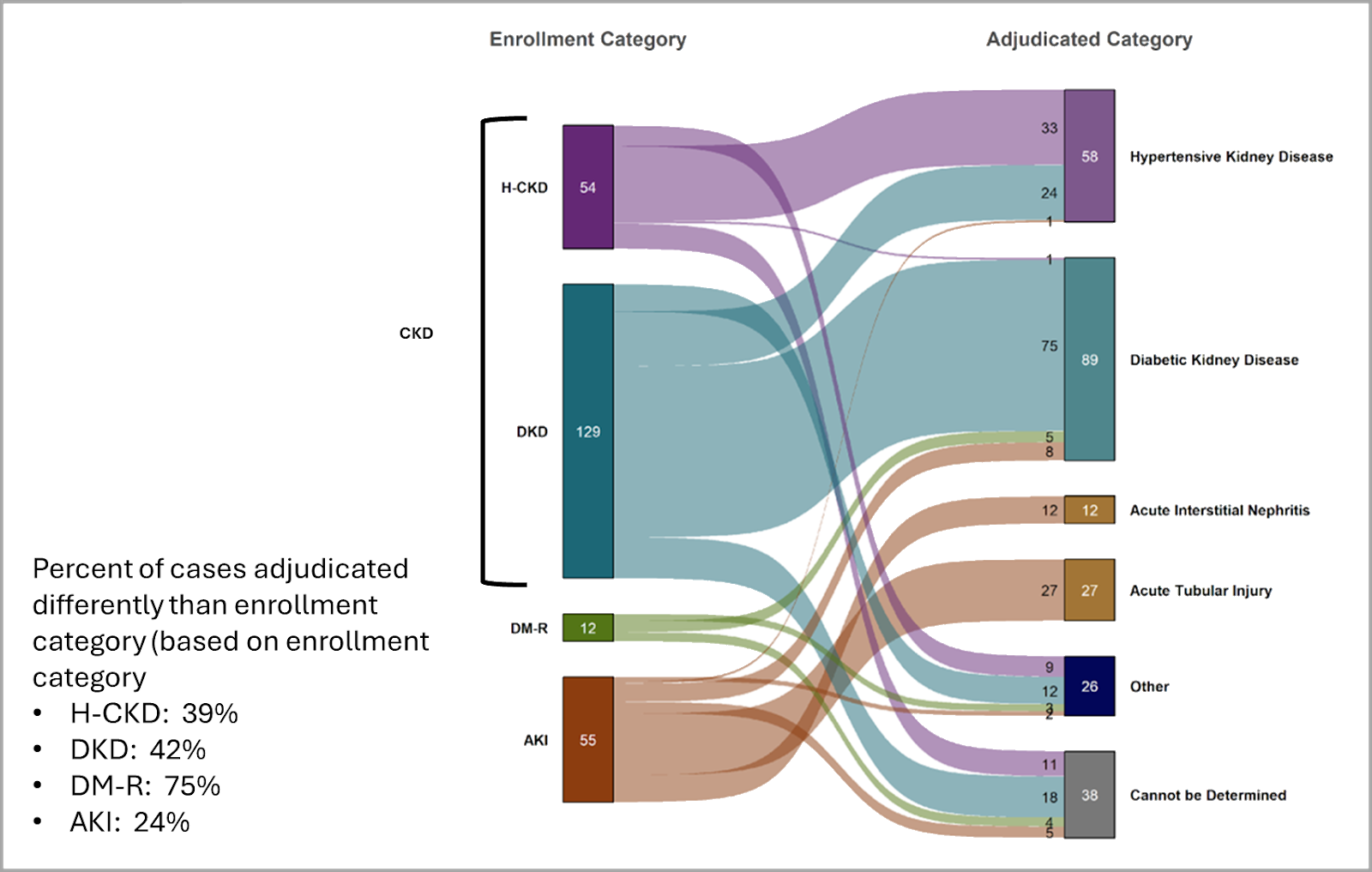
Enrollment vs Primary Adjudication
The KPMP Enrollment Category reflects how each participant is enrolled in the KPMP study prior to biopsy based on inclusion criteria. For more details on the KPMP study criteria, please visit our Clinician Resources page. KPMP biopsies of participants enrolled in the CKD, AKI, or DM-R cohorts (“Enrollment categories”) are adjudicated through a comprehensive review of the participant’s clinical history and kidney biopsy pathology by expert nephrologists and renal pathologists on a consensus basis (“Primary Adjudicated categories”). Enrollment category and Primary Adjudicated category may differ.
For example, take a participant presenting with AKI enrolled in the AKI enrollment category. Upon adjudication:
- Clinical history reveals a long-standing history of hypertension and diabetes.
- Pathology review shows significant diabetic, global, and segmental glomerulosclerosis and severe arteriolosclerosis with moderate arteriolar hyalinosis. While mild to moderate tubular and interstitial injury in this case is present, and therefore the enrollment category is correct, the chronic damage and long-standing clinical history are more notable. The adjudication team ascertains that the primary driver of this participant’s kidney disease is diabetic kidney disease.
- This participant would have an Enrollment category of AKI and a Primary Adjudicated category of Diabetic Kidney Disease.
This adjudication process ensures a more accurate classification of kidney disease by integrating both clinical and pathologic insights, which is crucial for research, treatment decisions, and understanding disease progression.
Figure 1 demonstrates that the Enrollment category and Primary Adjudicated category do not always align.